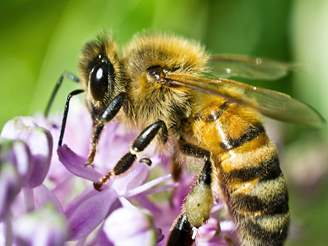
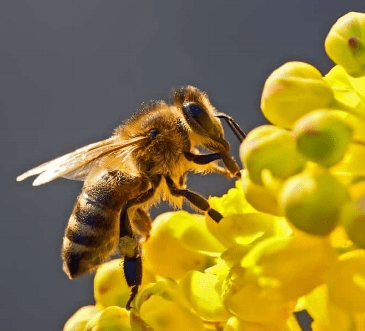
Technology tracks ‘bee talk’ to help improve honey bee health.

Simon Fraser University graduate student Oldooz Pooyanfar is monitoring what more than 20,000 honeybees housed in hives in a Cloverdale field are “saying” to each other — looking for clues about their health. Pooyanfar’s technology is gleaning communication details from sound within the hives with her beehive monitoring system — technology she developed at SFU. … More Technology tracks ‘bee talk’ to help improve honey bee health.
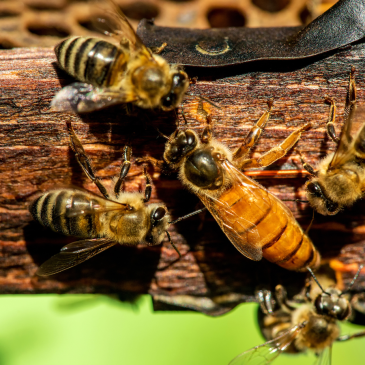
Exposure to neonic pesticides results in early death for honeybee workers and queens.

Worker and queen honeybees exposed to field realistic levels of neonicotinoids die sooner, reducing the health of the entire colony, a new study led by York University biologists has found. The researchers were also surprised to find that the neonicotinoid contaminated pollen collected by the honeybees came not from crops grown from neonicotinoid treated seeds, … More Exposure to neonic pesticides results in early death for honeybee workers and queens.

Insecticides are becoming more toxic to honey bees.

During the past 20 years, insecticides applied to U.S. agricultural landscapes have become significantly more toxic — over 120-fold in some mid-western states — to honey bees when ingested, according to a team of researchers, who identified rising neonicotinoid seed treatments in corn and soy as the primary driver of this change. The study is … More Insecticides are becoming more toxic to honey bees.

Insects in decline: On farmland, latecomers lose out.

Wild bees in Europe are in trouble — more than 50 percent of local species are now classified as endangered. Recent findings indicate that, in farming areas, species that emerge in late summer are most acutely threatened. The pollination services provided by wild bees are indispensable, not only for ecological but also for eminently economic … More Insects in decline: On farmland, latecomers lose out.

Breakthrough could aid development of bee-friendly pesticides.

Breakthrough could aid development of bee-friendly pesticides. Efforts to create pesticides that are not toxic to bees have been boosted by a scientific breakthrough. A joint study by the University of Exeter, Rothamsted Research and Bayer AG has discovered the enzymes in honeybees and bumblebees that determine how sensitive they are to different neonicotinoid pesticides. The … More Breakthrough could aid development of bee-friendly pesticides.

Study sheds light on ‘overlooked’ bee species.

The UK’s first citizen science project focusing on solitary, ground-nesting bees has revealed that they nest in a far broader range of habitats than previously thought. There are approximately 250 species of solitary bee in the UK, but far less is known about these important pollinators compared to honeybees or bumblebees. Although some previous studies … More Study sheds light on ‘overlooked’ bee species.

Pollen: The Hidden Sexuality of Flowers.

Rob Kesseler & Madeline Harley Foreword by Sir Peter Crane The extraordinary beauty and structure of pollen grains invisible to the naked eye. 200 x 220 mm 264 pages Hardback ISBN: 978-1-906506-51-3 £20.00 IPPY Gold Medal 2006 – Outstanding Book of the Year: Most Original Design Subjects: Nature, Photography First published ten years ago, this … More Pollen: The Hidden Sexuality of Flowers.

Adhesive formed from bee spit and flower oil could form basis of new glues.

Honey bees spend hours each day collecting pollen and packing it into tidy bundles attached to their hind legs. But all of that hard work could instantly be undone during a sudden rainstorm were it not for two substances the insect uses to keep the pollen firmly stuck in place: bee spit and flower oil. … More Adhesive formed from bee spit and flower oil could form basis of new glues.

Pollinator friendliness can extend beyond early spring.

A study out of the University of Arkansas investigated whether bulbs can flower and persist in warm-season lawns while providing nutrition for pollinating insects. Michelle Wisdom, Michael Richardson, Douglas Karcher, Donald Steinkraus, and Garry McDonald sought to determine the parameters by which bulbs can survive and be serviceable beyond their peak seasons. Their findings are … More Pollinator friendliness can extend beyond early spring.

Study shows EU pesticide ban failing to protect suburban bees.

Bees living in suburban habitats are still being exposed to significant levels of pesticides despite the EU ban on the use of neonicotinoid pesticides on flowering crops, new research from University of Sussex scientists shows. While the introduction of new EU restrictions on the use of neonicotinoid chemicals five years ago has reduced exposure of … More Study shows EU pesticide ban failing to protect suburban bees.