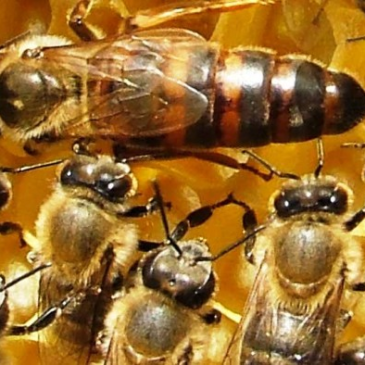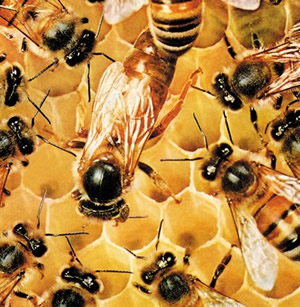
Queen bee or worker bee? New insights into honeybee society caste system.

Scientists are reporting deep new insights into whys and hows of the famous caste system that dominates honey bee societies, with a select few bee larvae destined for royalty and the masses for worker status. Their study probing the innermost biological makings of queen bees and worker bees appears in ACS’s Journal of Proteome Research. Jianke Li and colleagues … More Queen bee or worker bee? New insights into honeybee society caste system.

Sugar-poor diets wreak havoc on bumblebee queens’ health.

Flower losses due to shrinking habitats and climate change hurt prime pollinators. Without enough sugar in their diets, bumblebee queens can experience difficulty reproducing and shorter lifespans.   Hollis Woodard, assistant professor of entomology at UCR, has conducted multiple studies showing how loss of plant availability negatively affects the prolific pollinators. Previous research indicates a queen’s diet can impact how quickly her brood develops, … More Sugar-poor diets wreak havoc on bumblebee queens’ health.

U.S. beekeepers lost over 40 percent of colonies last year, highest winter losses ever recorded. Results point to a need for increased research, extension, and best management practices.

Beekeepers across the United States lost 40.7% of their honey bee colonies from April 2018 to April 2019, according to preliminary results of the latest annual nationwide survey conducted by the University of Maryland-led nonprofit Bee Informed Partnership. Honey bees pollinate $15 billion worth of food crops in the United States each year. The survey … More U.S. beekeepers lost over 40 percent of colonies last year, highest winter losses ever recorded. Results point to a need for increased research, extension, and best management practices.

To save honey bees, human behavior must change. Poor management practices have enabled spread of bee pathogens, bee researcher argues.

In the search for answers to the complex health problems and colony losses experienced by honey bees in recent years, it may be time for professionals and hobbyists in the beekeeping industry to look in the mirror. In a research essay to be published this week in the Entomological Society of America’s Journal of Economic Entomology, … More To save honey bees, human behavior must change. Poor management practices have enabled spread of bee pathogens, bee researcher argues.

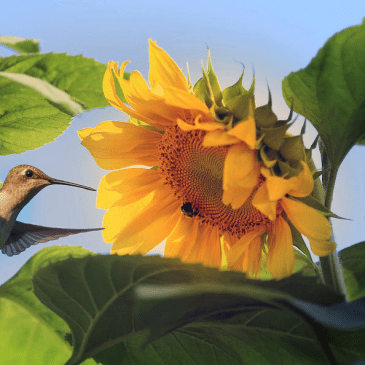
Sunflower pollen has medicinal, protective effects on bees.

With bee populations in decline, a new study offers hope for a relatively simple mechanism to promote bee health and well-being: providing bees access to sunflowers. The study, conducted by researchers at North Carolina State University and the University of Massachusetts Amherst, showed that two different species of bees fed a diet of sunflower pollen … More Sunflower pollen has medicinal, protective effects on bees.

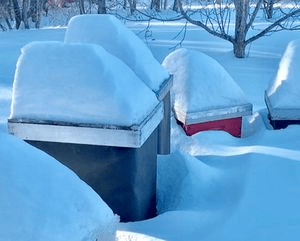
New tool improves beekeepers’ overwintering odds and bottom line.

A new tool from the Agricultural Research Service (ARS) can predict the odds that honey bee colonies overwintered in cold storage will be large enough to rent for almond pollination in February. Identifying which colonies will not be worth spending dollars to overwinter can improve beekeepers’ bottom line. Beekeepers have been losing an average of 30 percent of overwintered … More New tool improves beekeepers’ overwintering odds and bottom line.

Over 1 BILLION. That’s how many pounds of lethal pesticides we spray every year. More than 1 billion pounds of toxic chemicals that kill pollinators and endanger our food supply.

The European Union banned dangerous neonicotinoid pesticides more than TWO YEARS AGO, knowing they contribute to mass pollinator deaths. So why does the U.S. still use them? Because they make big money for corporations like Bayer-Monsanto. These and other Big Polluters are driving bumblebees, monarch butterflies and countless other pollinators to the brink of mass extinction.  We cannot let … More Over 1 BILLION. That’s how many pounds of lethal pesticides we spray every year. More than 1 billion pounds of toxic chemicals that kill pollinators and endanger our food supply.

Scientists find clues to queen bee failure.

Scientists at UBC are unravelling the mysteries behind a persistent problem in commercial beekeeping that is one of the leading causes of colony mortality — queen bee failure. This occurs when the queen fails to produce enough fertilized eggs to maintain the hive, and is regularly cited by the Canadian Association of Professional Apiarists as … More Scientists find clues to queen bee failure.

‘Intensive’ beekeeping not to blame for common bee diseases.

More “intensive” beekeeping does not raise the risk of diseases that harm or kill the insects, new research suggests. Intensive agriculture — where animals or plants are kept crowded together in very high densities — is thought to result in higher rates of disease spreading. But researchers from the University of Exeter and the University … More ‘Intensive’ beekeeping not to blame for common bee diseases.

Bee mite arrival in Hawaii causes pathogen changes in honeybee predators.

The reddish-brown varroa mite, a parasite of honeybees and accidentally introduced in the Big Island of Hawaii in 2007-08, is about the size of a pinhead. Yet, its effects there are concerning to entomologists because the mite is found nearly everywhere honeybees are present. A team led by entomologists at the University of California, Riverside, … More Bee mite arrival in Hawaii causes pathogen changes in honeybee predators.