Woolworths and Coles cave in to pressure to abandon product accused of killing bees

Coles and Woolworths are abandoning an insecticide product which contains a controversial ingredient that has been linked to harming bee populations essential for pollination, The New Daily can reveal. More than 30,000 Australians have signed a petition, launched by global consumer group SumOfUs, calling on Australian retailers to stop selling insecticides containing neonicotinoids, including Yates Confidor which has been … More Woolworths and Coles cave in to pressure to abandon product accused of killing bees

Bee decline threatens US crop production

First US wild bee map reveals 139 ‘trouble zone’ counties The first-ever study to map U.S. wild bees suggests they are disappearing in the country’s most important farmlands — from California’s Central Valley to the Midwest’s corn belt and the Mississippi River valley. A new study of wild bees identifies 139 counties in key agricultural … More Bee decline threatens US crop production

How honey bee gut bacteria help to digest their pollen-rich diet

he honey bee gut is colonized by specialized bacteria that help digest components of the floral pollen diet and produce molecules that likely promote bee health. In a study publishing 12 December in the open access journal PLOS Biology, a group of researchers led by Philipp Engel at the University of Lausanne and ETH Zürich, Switzerland, … More How honey bee gut bacteria help to digest their pollen-rich diet

Can Honeybees Monitor Pollution?

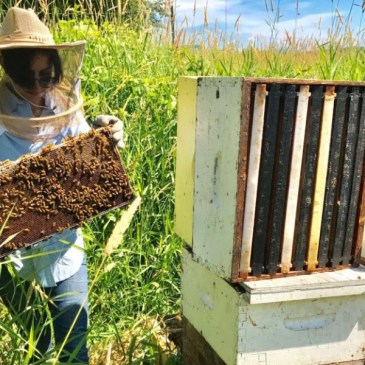
The tiny pollinators are useful sentinels of what’s going on in an ecosystem, and might just be environmentalists’ best asset. An apiarist tends to beehives at Hastings Urban Farm in Vancouver’s Downtown Eastside. (Courtesy M. Amini) By Rachel Kaufman It’s a sunny day, and Vancouver’s Downtown Eastside neighborhood is buzzing. Commuters are commuting, delivery trucks are delivering, … More Can Honeybees Monitor Pollution?

A Grassroots Organization Launch of ‘Back from the Brink’

Wednesday November 15, 2017 saw the official launch of one of the most ambitious conservation programmes in England – Back from the Brink. Project partners, volunteers and other distinguished guests met at Windsor Great Park to celebrate the launch of the programme, which aims to bring 20 species back from the brink of extinction. This is … More A Grassroots Organization Launch of ‘Back from the Brink’

Cross-kingdom regulation of honeybee caste development by dietary plant miRNAs

Honeybee larvae develop into workers but not queens, in part, because their diet of beebread/pollen is enriched in plant miRNAs. While miRNAs are generally negative regulators of gene expression in eukaryotes, they also negatively regulate larval development when honeybee larvae consume beebread/pollen and take up plant miRNAs. Xi Chen and Chen-Yu Zhang’s group in Nanjing … More Cross-kingdom regulation of honeybee caste development by dietary plant miRNAs

Bumble bees make a beeline for larger flowers

Bumble bees create foraging routes by using their experience to select nectar-rich, high-rewarding flowers. A study now suggests that bees actually forage more efficiently when flower sizes are large rather than small. This indicates that for these insect pollinators foraging quickly is more efficient than foraging accurately. Bumble bees create foraging routes by using their … More Bumble bees make a beeline for larger flowers

Climate change threatens domestic bee species

There are around 550 different bee species in Germany. Most of them are solitary bees. They don’t live in large beehives like the honeybee, but each female bee often builds multiple nests and feeds her offspring alone. Solitary bees use their short lifespan of a few weeks exclusively to reproduce and to provide food for … More Climate change threatens domestic bee species

Technology tracks ‘bee talk’ to help improve honey bee health

A researcher has devised a new bee monitoring system to better understand what more than 20,000 honeybees housed in hives in a local field are ‘saying’ to each other — looking for clues about their health.  Simon Fraser University graduate student Oldooz Pooyanfar is monitoring what more than 20,000 honeybees housed in hives in a … More Technology tracks ‘bee talk’ to help improve honey bee health