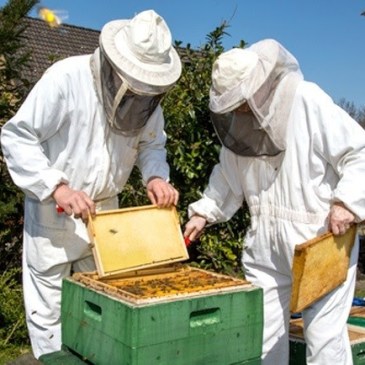
Scientists track gene activity when honey bees do and don’t eat honey: Significant differences depending on diet

Many beekeepers feed their honey bees sucrose or high-fructose corn syrup when times are lean inside the hive. This practice has come under scrutiny, however, in response to colony collapse disorder, the massive — and as yet not fully explained — annual die-off of honey bees in the U.S. and Europe. Some suspect that inadequate … More Scientists track gene activity when honey bees do and don’t eat honey: Significant differences depending on diet

The weaker sex: Male honey bees more susceptible than females to widespread intestinal parasite

A research team has found that male European honey bees, or drones, are much more susceptible than female European honey bees, known as workers, to a fungal intestinal parasite called Nosema ceranae. Originally from Asia, Nosema ceranae has rapidly spread throughout the world, and may contribute to the high number of colony deaths now observed … More The weaker sex: Male honey bees more susceptible than females to widespread intestinal parasite

New data unearths pesticide peril in beehives

Honeybees create honey in their hive through the topped-out combs, and they keep beebread — their food — in the other combs. Credit: © gudrin / Fotolia Honeybees — employed to pollinate crops during the blooming season — encounter danger due to lingering and wandering pesticides, according to a new Cornell University study that analyzed … More New data unearths pesticide peril in beehives

Ball-rolling bees reveal complex learning

Bumblebees can be trained to score goals using a mini-ball, revealing unprecedented learning abilities, according to scientists at Queen Mary University of London (QMUL). Their study, published in the journal Science, suggests that species whose lifestyle demands advanced learning abilities could learn entirely new behaviours if there is ecological pressure. Project supervisor and co-author Professor … More Ball-rolling bees reveal complex learning

Nutrition matters: Stress from migratory beekeeping may be eased by access to food

In the first large-scale and comprehensive study on the impacts of transporting honey bees to pollinate various crops, North Carolina State University research shows that travel can adversely affect bee health and lifespan. Some of these negative impacts may be reduced by moving bee colonies into patches with readily available food or by providing supplemental … More Nutrition matters: Stress from migratory beekeeping may be eased by access to food

Wild bee decline threatens US crop production

Following Obama’s call for pollinator assessment, first-ever national bee map shows much farmland at risk The first national study to map  US wild bees, from the University of Vermont, suggests they’re disappearing in many of the country’s most important farmlands. If losses of these pollinators continue, the new nationwide assessment indicates that farmers will face … More Wild bee decline threatens US crop production

Supporting pollinators could have big payoff for Texas cotton farmers

Increasing the diversity of pollinator species can dramatically increase cotton production, according to a new study from the University of Texas at Austin. In South Texas alone, this could boost cotton production by up to 18 percent, yielding an increase in annual revenue of more than $1.1 million. Bee hovers over cotton flower in South … More Supporting pollinators could have big payoff for Texas cotton farmers

Ornamental plants for conserving bees and other beneficial insects

Insects play a vital role in ecosystem health, helping to aerate soil, keeping the natural system in balance, and preventing detrimental pests from taking over essential natural resources, according to the American Society for Horticultural Science. Additionally, insects provide critical biological services such as pollination and biological controls. The authors of a study say that … More Ornamental plants for conserving bees and other beneficial insects

American beekeepers lost 44 percent of bees in 2015-16

American beekeepers lost 44 percent of bees in 2015-16 Summer losses rival winter losses for the second year running United States beekeepers lost 44 percent of their honey bee colonies from April 2015 to April 2016, according to the latest preliminary results of an annual nationwide survey. This is a higher overall loss rate than … More American beekeepers lost 44 percent of bees in 2015-16