This Sculpture Is Controlled by Live Honeybees

Artist Wolfgang Buttress collaborated with a multidisciplinary team to create a giant, metallic hive By Marissa Fessenden Smithsonian.com   To reach artist Wolfgang Buttress‘s new sculpture, one must first walk through a field of wildflowers. From a distance, the installation seems to float above swaying blooms, like a gossamer cloud or a swarm of gnats. … More This Sculpture Is Controlled by Live Honeybees
Diesel fumes may be reducing flower odors which bees need to find food

In polluted environments, diesel fumes may be reducing the availability of almost half the most common flower odors that bees use to find their food, research has found. This is an electron scanning microscope image of a bee. Credit: Dr Robbie Girling The new findings suggest that toxic nitrous oxide (NOx) in diesel exhausts could … More Diesel fumes may be reducing flower odors which bees need to find food

Bees’ ability to forage decreases as air pollution increases Air pollutants interact with and break down p

Air pollutants interact with and break down plant-emitted scent molecules, which insect pollinators use to locate needed food, according to a team of researchers. The pollution-modified plant odors can confuse bees and, as a result, bees’ foraging time increases and pollination efficiency decreases. This happens because the chemical interactions decrease both the scent molecules’ life … More Bees’ ability to forage decreases as air pollution increases Air pollutants interact with and break down p

Honeybee circadian rhythms are affected more by social interactions

For the first time, a field study shows that social time cues override influence of light and darkness in regulating the natural body clock of honeybees, highlighting the complexity of clock regulation in natural habitat   Nurse honey bees working around the social clock at an experiment by Hebrew University researchers. Credit: Muki Nagari Circadian … More Honeybee circadian rhythms are affected more by social interactions

France moves towards full ban on neonics blamed for harming bees

PARIS (Reuters) – French lawmakers approved plans for a total ban on some widely used pesticides blamed for harming bees, going beyond European Union restrictions in a fierce debate that has pitched farmers and chemical firms against beekeepers and green groups. The EU limited the use of neonicotinoid chemicals, produced by companies including Bayer Crop … More France moves towards full ban on neonics blamed for harming bees

Bees and pesticides ‘missing link’ found

Scientists say they have found the “missing link” in the debate over the risk of pesticides to bees. French researchers say neonicotinoid pesticides harm individual honeybees, but whole colonies are able to recover in the wild. This accounts for discrepancies between lab and field studies, they report in Royal Society Journal Proceedings B. A Europe-wide … More Bees and pesticides ‘missing link’ found

Bumble bees in the last frontier, Alaska

A decline in bumble bee populations in Europe and North America has been documented in a number of recent publications. Meanwhile, little is known about bee populations in Alaska, where native bee pollination is critical to the maintenance of subarctic ecosystems. Researchers have now completed a two-year study on bumble bees in agricultural areas in … More Bumble bees in the last frontier, Alaska

Picky eaters: Bumble bees prefer plants with nutrient-rich pollen

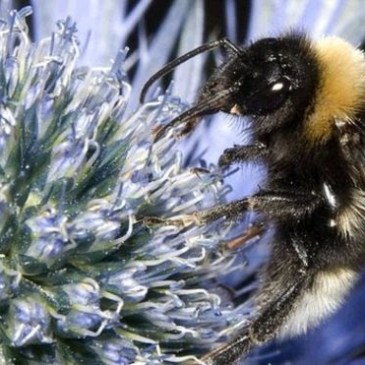
Bumble bees have discriminating palates when it comes to their pollen meals, according to researchers. The researchers found that bumble bees can detect the nutritional quality of pollen, and that this ability helps them selectively forage among plant species to optimize their diets. The scientists conducted a laboratory cage study in which they placed bees … More Picky eaters: Bumble bees prefer plants with nutrient-rich pollen

Wildflowers on farms — not just crops — can expose bees to neonicotinoids

Since bee colonies started declining at alarming rates over the past few decades, some scientists have identified a group of pesticides called neonicotinoids that are commonly used on crops as a potential contributor. A team reports in American Chemical Society’s journal Environmental Science & Technology that bees could be getting an unexpected dose of neonicotinoids … More Wildflowers on farms — not just crops — can expose bees to neonicotinoids